
Scientists claim that new 3D printed insoles can significantly improve the foot health of people suffering with diabetes.
With numerous patients losing their limbs to diabetic foot disease, our research will help clinicians effectively manage this disease.”
This study offers hope for millions of patients with diabetes who are at risk of developing foot ulcers, which in many cases end up in amputation. It presents the first quantitative evidence in support of optimised cushioning in diabetic footwear as part of standard clinical practice.
In their latest paper [‘Optimised cushioning in diabetic footwear can significantly enhance their capacity to reduce plantar pressure’] published in Gait and Posture, researchers conclude that selecting the correct cushioning stiffness in footwear can significantly reduce pressures experienced on the feet which can lead to ulcers and other painful complications.
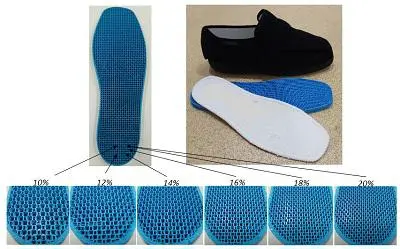
In the study carried out in Malta, 15 participants with diabetic foot disease were asked to walk in footwear fitted with made to measure 3D-printed insoles designed by the Centre for Biomechanics and Rehabilitation Technologies (CBRT) at Staffordshire University. These footbeds were used to change the stiffness of the entire sole across a spectrum of very soft to very stiff.
Dr Chatzistergos, Associate Professor at CBRT and the lead author of ths study said: “The optimum stiffness is clearly related to the patient’s body mass index (BMI). This study adds to our earlier findings and concludes that stiffer materials are needed for people with a higher BMI.”
Collaborators Dr Alfred Gatt and Dr Cynthia Formosa from the University of Malta and Visiting Fellows at CBRT provided clinical support for this study and led the experiments in Malta. Dr Gatt noted: “We hope that the results reported within this study will generate interest amongst all professionals managing this debilitating condition.”
Further work is now underway to develop a method to help professionals identify the optimum cushioning stiffness on a patient-specific basis. Professor Nachi Chockalingam, Director of CBRT and a co-inventor of the technology said “With numerous patients losing their limbs to diabetic foot disease, our research will help clinicians effectively manage this disease.”