
University of Staffordshire students are helping to shed new light on microplastic pollution following an international expedition
It gives a different experience to standard learning, from the planning of the expedition to the sampling itself and everything in between. This gives you a real chance to develop your skills.
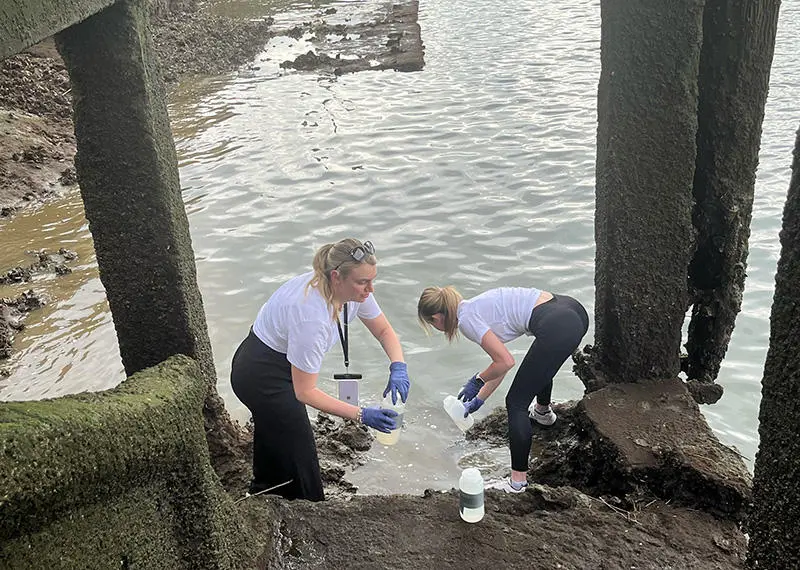
A team of 18 undergraduate Forensic Science and Forensic Investigation students took part in a ‘Forensic Field School’, organising a research expedition to Spain as part of their studies.
The group carried out research on the Nervión River in Bilbao, to understand the extent of microplastic pollution and help to identify sources of the contamination.
Bilbao is one of Spain’s most significant ports and the study area sampled is a mix of freshwater and saltwater, providing a unique ecosystem of ecological importance that supports a diverse range of species.
Supervised by their lecturer Professor Claire Gwinnett – a world-renowned expert in fibre analysis – the students collected water samples at 37 points along the River Nervión. Back in the UK, they have been analysing the microplastics found in the samples using forensic fibre techniques and polarized light microscopy.
Forensic fibre analysis is an established technique within forensic science. However, University of Staffordshire was the first globally to apply these forensic techniques to the sampling, extraction and analysis of microplastics.
“Most anthropogenic contaminants found in aquatic environments are fibrous. This is largely due to significant input from sources such as synthetic textile waste, urban runoff, and laundry effluent. Understanding the source distribution is essential for developing effective mitigation activities,” explained Gwinnett, Professor of Forensic and Environmental Science.
“The students’ findings offer new insights into freshwater contamination and contribute to global discussions on environmental protection.”
The analysis identified microplastics in 92% of the sample sites. Of the 141 microplastic particles found, 98% were fibres – mostly natural textiles like dyed cotton and wool – with synthetic fibres making up 13%. The study revealed that residential areas showed the highest levels of pollution, while commercial areas had the least.
This is the first forensic microplastic student expedition globally – designed, planned and implemented all by undergraduate students. It not only allowed them to put the skills that they have learned on the course into practice, but to contribute important data on the prevalence of microplastic pollution.
Forensic Investigation student Davey Ball said: “I would recommend this as a way of experiencing a different side of research, in addition to being a great method of improving time-management and social skills.
“My favourite part was seeing the locals get equally invested in getting our sample bucket back each time it got stuck, even bringing along different items to help!”
Course mate Lucie Pepper added: “I enjoyed being part of a proper science expedition and having a hands on experience of research in the field…being in Spain and calling it work was pretty cool.
“It gives a different experience to standard learning, from the planning of the expedition to the sampling itself and everything in between. This gives you a real chance to develop your skills that normal university learning doesn’t.”
Get ahead of results day and discover University of Staffordshire’s range of future-ready courses – apply through Clearing and get an instant decision online.