
Researchers are exploring how forensic science can be adapted to extraterrestrial environments
We find ourselves in a new era of forensic science; just as mid-19th century research asked the question of what a bloodstain meant in relation to cause; we are once again at the beginning of new questions that tie in how new environments influence forensic science.
As more people seek to go where no man has gone before, researchers are exploring how forensic science can be adapted to extraterrestrial environments.
A new study by Staffordshire University and the University of Hull highlights the behaviour of blood in microgravity and the unique challenges of bloodstain pattern analysis aboard spacecraft.
Bloodstain expert Zack Kowalske is a Crime Scene Investigator based in Atlanta, USA, and led the study as part his PhD research at Staffordshire University.
“Studying bloodstain patterns can provide valuable reconstructive information about a crime or accident. However, little is known about how liquid blood behaves in an altered gravity environment. This is an area of study that, while novel, has implications for forensic investigations in space,” he commented.
“Forensic science is more than just trying to solve crimes; it additionally has a role in accident reconstruction or failure analysis. With this concept, consider how various forensic disciplines could be utilized in a critical accident onboard a space station or shuttle.”
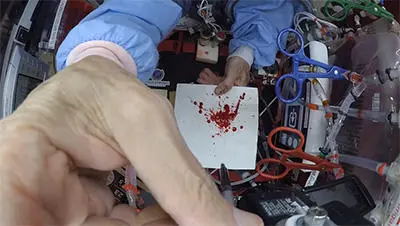
Experiments were conducted aboard a Zero Gravity Corporation modified Boeing 727 parabolic aircraft. A mixture of 40% glycerin and 60% red food colouring was used, simulating the relative density and viscosity of human blood. Blood droplets were propelled from a hydraulic syringe toward a target during periods of reduced gravity between 0.00 and 0.05 g. From these blood stains, the researchers reconstructed the angle of impact.
Co-author Professor Graham Williams, from the University of Hull, explained: “With the lack of gravitational influence, surface tension and cohesion of blood droplets are amplified. What this means is that blood in space has a higher tendency to stick to surfaces until a greater force causes detachment. Within the application of bloodstain formation, it means that blood drops exhibit a slower spread rate and, therefore, have shapes and sizes that would not be reflective on Earth.
“On Earth, gravity and air drag have a noticeable influence on skewing the calculated angle. The initial hypothesis was that because of the absence of gravity, certain mathematical calculations would be more accurate. However, the amplified effect of surface tension became a predominant factor that caused the calculation to have greater variance, even in the absence of gravity.”
This is the first study relating to the behavior of blood in free flight. With the rate of technological evolution in space exploration, the authors say that the need for reliable forensic science techniques will become increasingly important.
Zack added: “We find ourselves in a new era of forensic science; just as mid-19th century research asked the question of what a bloodstain meant in relation to cause; we are once again at the beginning of new questions that tie in how new environments influence forensic science.
“Astroforensics is a novel subdiscipline that is in its infancy. Broadening the understanding of all forensic sciences in non-terrestrial environments is critical as we expand into a space-faring species. Research is needed, research that spans across all disciplines.”
Read the full paper Bloodstain pattern dynamics in microgravity: Observations of a pilot study in the next frontier of forensic science.
Read more about the study on The Conversation We’re working out how to solve crimes in space – the final frontier of forensic science.