
A new degree apprenticeship is helping to address the national shortage of maths teachers by offering a paid, debt-free route into the profession
This was the only way I was ever going to become a teacher. It’s tailor-made for people like me who can’t afford to stop earning while they study.
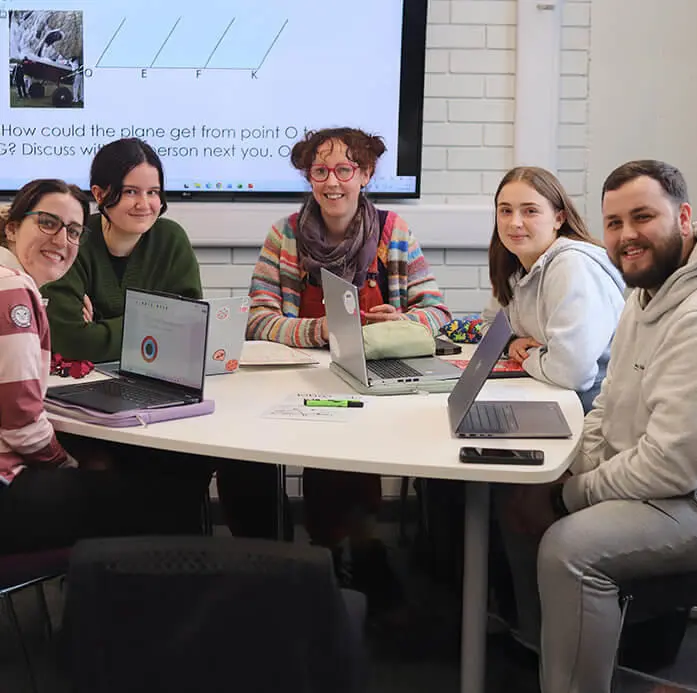
University of Staffordshire’s Teacher Degree Apprenticeship (TDA) in Secondary Mathematics allows trainees to earn a salary working in schools, while studying for a degree and gaining qualified teacher status (QTS).
University of Staffordshire has been working with leading employers to deliver higher and degree level apprenticeships for the past decade. It is one of six providers piloting the Department for Education initiative and welcomed its first cohort in September 2025. Of the 54 apprentices enrolled nationally, 14 are studying at Staffordshire.
Course Director Kate Dale said: “Apprenticeships are well established in areas like nursing and policing, but not in teaching. Recruiting and retaining maths teachers is a challenge for many schools, so we have worked collaboratively with our partners to design this alternative route into the profession.
“Many of our students have come from outside of Staffordshire to train with us. So, we’re also now bringing people into the region to teach who wouldn’t have otherwise.”
The programme was developed in partnership with the Stoke and Staffordshire Teacher Education Collective (SSTEC) and the Golden Thread Teaching School Hub. Dr Di Swift OBE, Chair of SSTEC, said the scheme supports workforce diversity: “The University of Staffordshire teams are relentlessly focused on creating opportunities for a more inclusive teaching workforce through well-designed apprenticeship programmes. It is a privilege to work alongside them for the benefit of the communities that we all serve.”
The apprentices spend most of their time teaching in partner schools, alongside 40% off-the-job learning over four years. For many, the paid, hands-on model has made teaching possible for the first time.
Kyle Brotherton-Chidlaw, who has worked as a youth worker for the past decade, said the apprenticeship removed financial barriers that had previously ruled out teaching.
The 27-year-old from Warrington, explained: “I always wanted to be a maths teacher but no one in my family had been to university and it was never an option financially. This was the only way I was ever going to become a teacher. It’s tailor-made for people like me who can’t afford to stop earning while they study.”
Kimberley Winfer, 21, from Stafford, decided to train to teach after working as a teaching assistant and said the apprenticeship suits her learning style: “I struggle with exams and exam pressure, so the idea of going to uni was quite daunting. The apprenticeship suits me because I learn best through hands-on experience. The fact that you don’t have any student debt also really appealed to me.”
Caroline Gilbert, 43, who previously worked as a learning support assistant in Herefordshire, agreed that the structure of the course helps to build confidence. “Compared with the traditional PGCE route, the apprenticeship builds you up over the four years in a supportive way,” she said. “It’s a really secure way into teaching, especially for those haven’t worked in a school before.”
The University is currently partnered with 13 schools to deliver the TDA and is looking to work with more schools to support the next intake of apprentices.
“Schools that employ trainees as part of the pilot will receive financial incentives to support with apprentice salary costs. We’re collaborating with schools locally but also across the country, so the distance from the university shouldn’t put off schools from considering working with us,” commented Course Leader Matt Linney.
He said the four-year structure also supports teacher retention: “The whole idea is a slow-burn approach where skills are built over time. By the time apprentices qualify, they’ve learned to manage workload and work-life balance, which we hope will support long-term retention.”
To mark National Apprenticeship Week, the University is hosting an Apprenticeship Fair at its Stoke-on-Trent campus on Saturday 7 February 2026, 9am - 3pm, where members of the public can learn more about the apprenticeships on offer.
A free online webinar about the University’s teaching apprenticeships will also take place on Thursday 12 February, 3.35 - 4.45pm, for those interested in the Teacher Degree Apprenticeship (TDA) in Secondary Mathematics, as well as the Postgraduate Teacher Apprenticeship and a new Specialist Teaching Assistant Apprenticeship.
Discover more about apprenticeships at University of Staffordshire at https://www.staffs.ac.uk/apprenticeships.