
University of Staffordshire students have been on a ‘once-in-a-lifetime’ trip to learn about the role of forensics in combating wildlife crime
Learning about wildlife crime on this trip has been one of the most eye-opening experiences of my life
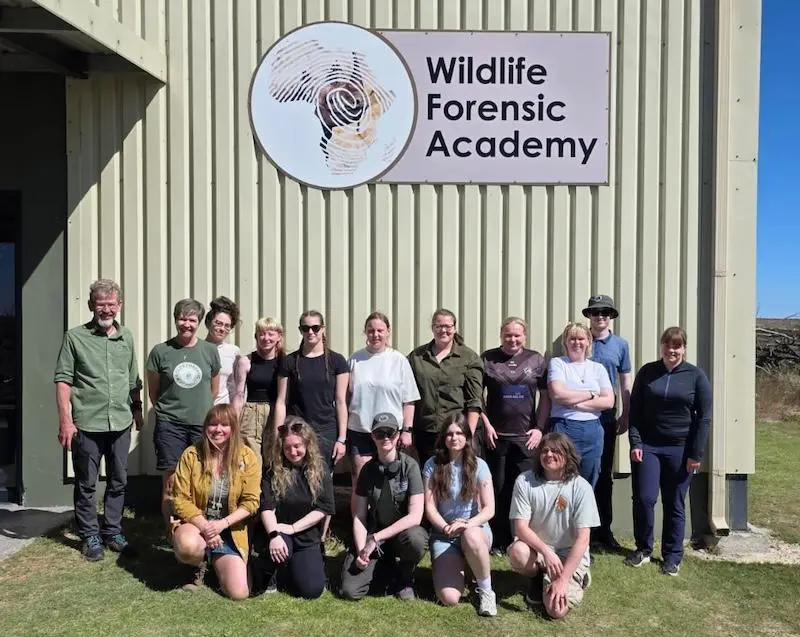
13 (Hons) Forensic Science and BSc (Hons) Forensic Investigation students travelled to the Wildlife Forensic Academy (WFA) in South Africa, where they received specialised training in wildlife forensics to address crimes such as poaching and illegal animal trading.
Through lectures, practical sessions and field trips, the group learned about the current global scale of wildlife crime and how to manage, document and recover evidence from crime scenes. Several students also had the opportunity to work on a real case with the WFA’s Dr Greg Simpson and University lecturer Professor Claire Gwinnett.
First year Forensic Science student Isla Kelly described the experience as transformative.
"Learning about wildlife crime on this trip has been one of the most eye-opening experiences of my life,” she said. “Talking in depth about a topic known to so many in the UK but rarely discussed in detail has opened my eyes to another side of forensics that I would never have considered before.
“The trip included both the theoretical and practical aspects of wildlife forensics, such as learning about South African ecology in the classroom and also on hikes and road trips. We spent plenty of time in both the lab and the WFA’s simulated crime-scene facilities, which provided vital insight into situations often encountered in the field.”
Some of the students were able to go on the trip thanks to support from the University’s Careers Team, which provides Go Abroad opportunities through Turing Scheme funding.
This includes MSci student Abigail Finnigan who is staying in South Africa to complete a 12-week placement at the WFA, to research entomological evidence on animal carcasses.
University of Staffordshire’s Professor Claire Gwinnett helped to establish the WFA’s training courses in South Africa, helping the team to design the curriculum and incorporate cutting edge forensic techniques.
She said: “This trip has been an incredible opportunity for our students to gain hands-on insight into how forensics can be used to tackle wildlife crime and contribute to protecting biodiversity and endangered species worldwide.
“Wildlife crime is a growing issue and we need future forensic professionals with the correct skills to address it. The scientific methods that our students learn on their degrees can be adapted and applied to investigate crimes against protected species – DNA analysis, trace evidence examination, and crime scene documentation can all be used to link suspects to wildlife crimes and increase convictions.”
Professor Gwinnett is an internationally renowned expert in fibre analysis, including animal hairs. During the trip, a new Forensic Animal Hair for Wildlife Crime Investigations Research Group was established, with Gwinnett training University of Staffordshire students, researchers from the WFA, Stellenbosch University (South Africa) and Saxion University (Netherlands) in animal hair examinations.
The group will now collaborate on new research on the intra and inter variation in microscopical features in hair from animals persecuted by wildlife crime, including African Lions and Giraffe.
“Animal hairs are actually more interesting than human hairs,” Gwinnett commented. “Each species has its own distinctive characteristics. In wildlife crime, that helps identify an animal, trace the origin of poached animal products, or link animals and people to a crime scene.”
Andro Vos, CEO of the WFA, said: “The new Forensic Animal Hair for Wildlife Crime Investigations Research Group is fantastic and gives a new horizon for research at the WFA; it is precious for us to collaborate with Professor Gwinnett on this.”
Isla is one of the students who will be continuing this research back in the UK at University of Staffordshire.
“It is an amazing opportunity to help Professor Claire Gwinnett with her research, sampling, and analysing giraffe hairs, which is something not many first-year students can say they have done.”
She added: “Altogether, this trip has been a once-in-a-lifetime opportunity to experience South Africa's culture whilst also learning a lot about the challenges faced by local law enforcement in the fight against poaching and wildlife crime, and I would strongly encourage anyone who can to go on this trip."
The story of the WFA and its beginnings – including University of Staffordshire’s involvement – has recently been turned into a book by its founder Andro Vos. Following the Trail – From Dream to a Global Weapon Against Wildlife Crime will be launched globally on 25 March.
Discover more about studying at University of Staffordshire at an Open Day – book your place.